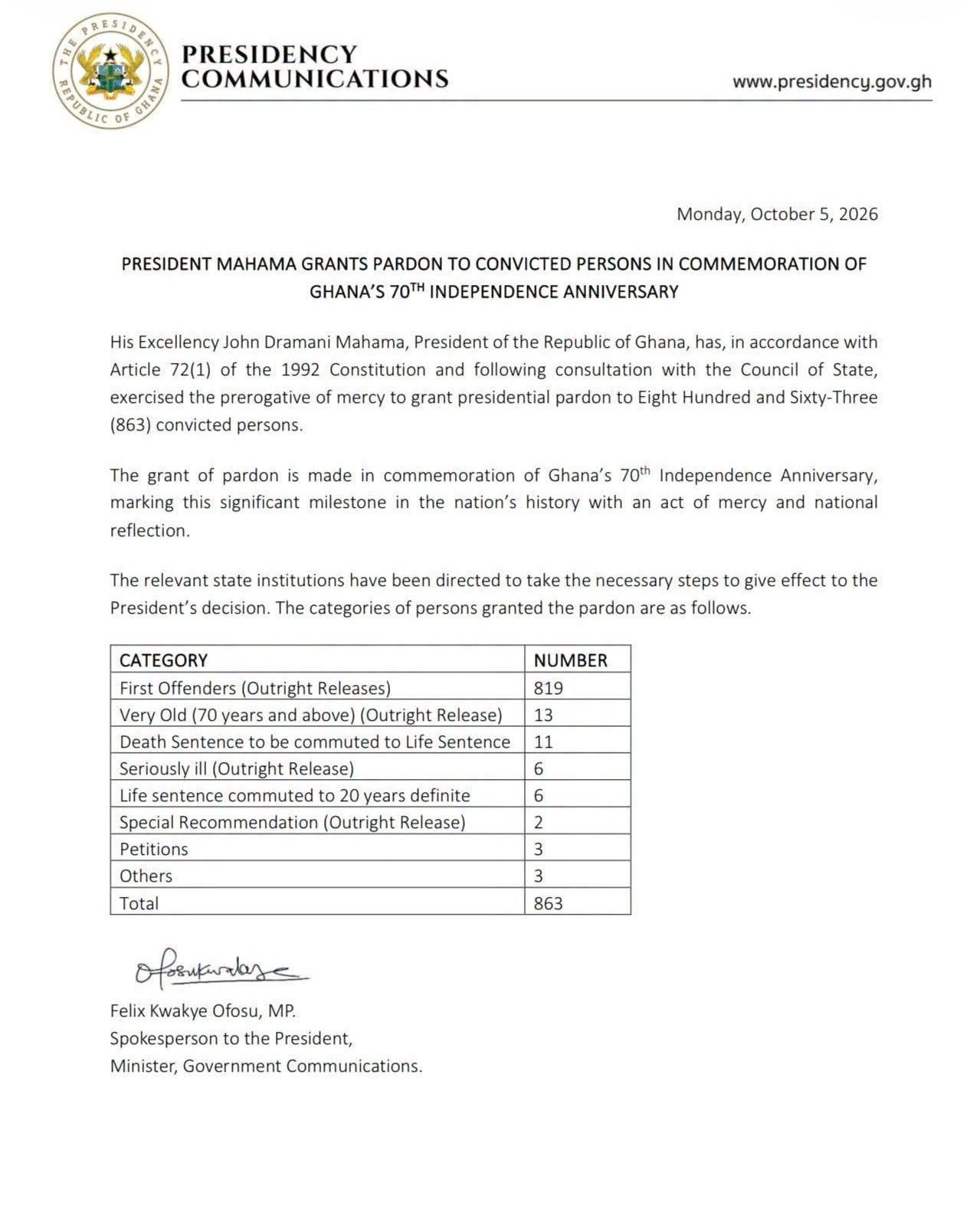
On 5 October 2026, President John Dramani Mahama exercised the prerogative of mercy under Article 72 of the 1992 Constitution in favour of 863 convicted persons in commemoration of Ghana’s 70th independence anniversary. According to the official announcement, 819 first offenders were granted outright release, together with 13 prisoners aged 70 years or above, 6 seriously ill prisoners and 2 persons released on special recommendation. in addition, 3 persons were pardoned following petitions, while another 3 were placed in an unspecified category of “others.” The President also commuted 11 death sentences to life imprisonment and 6 life sentences to definite terms of twenty years. It was stated that the decision was taken after consultation with the Council of State.
Pardons have positive implications for reducing prison congestion and promoting rehabilitation, especially for first time offenders. In addition, it is an important part of Ghana’s criminal justice policy and the move towards less punitive measures. There is however an important legal question regarding the exercise: what is the legal effect of a presidential pardon in Ghana, particularly in cases where a pardon ends a prison sentence? This article examines the implications of a pardon for the recipients and other factors that ought to be considered regarding this prerogative.
The starting point is that Ghanaian criminal law distinguishes between a conviction, the sentence imposed following that conviction, and some of the legal consequences that arise because of it. And so a pardon may affect these in different ways. The 1992 Constitution, the Criminal and Other Offences (Procedure) Act, 1960 (Act 30), the constitutional rules governing eligibility for public office, and the courts’ interpretation of the prerogative of mercy therefore have to be read together to understand the consequences.
The Constitutional Power to Pardon
Let’s begin with the clemency power itself, formally referred to as the prerogative of mercy. The President’s power derives principally from Article 72 of the 1992 Constitution. The provision in article 72(1) states that the President may, acting in consultation with the Council of State, do any of the following:
- grant to a person convicted of an offence a pardon either free or subject to lawful conditions; or
- grant to a person a respite, either indefinite or for a specified period, from the execution of punishment imposed on him for an offence; or
- substitute a less severe form of punishment for a punishment imposed on a person for an offence; or
- remit the whole or part of a punishment imposed on a person or of a penalty or forfeiture otherwise due to Government on account of any offence.
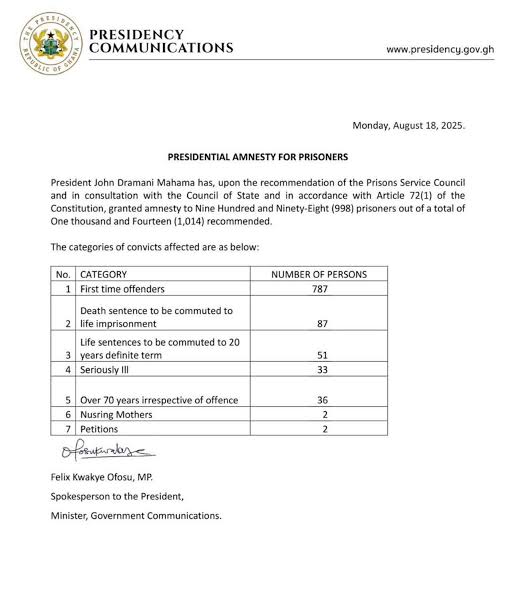
The first observation is that the prerogative of mercy is exercised at the discretion of the president and cannot be compelled merely by the filing of a petition by a convicted and sentenced person, but individuals are still at liberty to petition the Presidency. Also note that the president may receive recommendations from the Prisons Service Council to exercise this prerogative, as was seen in the presidential amnesty announcement dated August 18, 2025. Second, the exercise of this power is not unilateral, but is in consultation with the Council of State regardless of how the pardon process is initiated, whether by petition, recommendation or on the president’s own initiative.
Third, and more important to the discussion in this paper, article 72 establishes several legally distinct forms of executive clemency, all with different implications. A free pardon is different from a respite, and both are different from the substitution of one punishment for another or the remission of part of a punishment. The distinction can be seen in the current exercise of the pardon: the first offenders who have been granted outright release are not in the same legal position as the eleven prisoners whose death sentences have been commuted to life imprisonment. The latter remain incarcerated, but the punishment imposed upon them has been replaced with a less severe one in accordance with article 72(1)(c). Similarly, reducing a life sentence to twenty years does not amount to releasing the prisoner or setting aside the conviction. Thus, even though we commonly use the expression “presidential pardon” to broadly describe any exercise of the prerogative of mercy, we must differentiate among the forms that the exercise may take to appreciate the legal consequences for a recipient.
The Courts Act, 1993 (Act 459) also provides an interesting connection between executive clemency and the judiciary. Where a petition for the prerogative of mercy concerns a conviction or sentence imposed by a court established under the Act, section 9 permits the President, except in death-sentence cases, to refer the whole case to the Supreme Court to be determined as an appeal or to refer a particular point to the Court for its opinion. The existence of this procedure is meaningful because it shows a critical distinction between the President’s constitutional power under article 72 and the judicial determination of the validity of a conviction. The appeal in section 9(a) follows the legal rules and standards of regular appeals in Act 459 and Act 30, but the wording of section 9(b) suggests that the opinion may follow a different path. Note that the section does not take away from the constitutional power of the president, but gives the president access to judicial consideration as a form of assistance in the exercise of this power. The section reads:
Section 9—Certain Functions of Supreme Court Relating to the Prerogative of Mercy.
Where a person has been convicted or sentenced for an offence by a court established under this Act and a petition is presented to the President for the grant of the prerogative of mercy in respect of the conviction or sentence, the President may, except in the case of sentence of death
- (a) refer the whole case to the Supreme Court and the case shall then be heard and determined by that Court as in the case of an appeal by a person convicted; or
- (b) if the President desires the assistance of the Supreme Court on any point arising in the case with a view to the determination of the petition, refer that point to that Court for its opinion and the Supreme Court shall consider the point referred and furnish the President with its opinion.
The constitutional relationship between the courts and the President’s prerogative of mercy was considered further by the Supreme Court in Agbemava and Others v Attorney-General [2018] GHASC 52. The case arose from the 2016 exercise of the prerogative of mercy in favour of three persons convicted and sentenced by the Supreme Court for criminal contempt. After consultation with the Council of State, the President remitted part of their terms of imprisonment. The challenge included the argument that this constituted an unjustified interference with judicial independence. The majority rejected that argument, holding that criminal contempt is an offence within the meaning of Article 72 and that persons convicted of it may therefore benefit from the prerogative of mercy. The fact that the Supreme Court imposed the punishment did not exclude it from the scope of that constitutional power. In essence, the court confirmed the breadth of the constitutional expression “a person convicted of an offence.” Article 72(3) further makes clear that the provision encompasses convictions and punishments imposed by a court martial or other military tribunal.
The majority in Agbemava also considered the relationship between article 72 and article 296, including its application to the Council of State’s advisory role. Article 296 requires fairness, candour and due process in exercising discretionary powers and prohibits arbitrariness, caprice and bias. It also provides for published regulations governing discretion. The majority held that the President was not required to publish separate regulations under Article 296(c) where he had complied with Article 72’s constitutional mandate. Regarding the Council of State, general rules governing its operations could suffice without separate regulations for each advisory function. Finding that consultation had occurred and no evidence that the Council’s advice had been unlawfully influenced, the majority declined to interfere with the remission of sentence.
Does a Pardon Extinguish a Conviction?
A reading of Article 72(1)(a) of the Constitution alongside section 9 of the Courts Act, 1993 (Act 459) may create the impression that a pardon can extinguish a conviction. Article 72(1)(a) authorises the President to grant a person convicted of an offence a pardon, either free or subject to lawful conditions, while section 9 contemplates a petition for mercy “in respect of the conviction or sentence”. Neither provision, however, expressly states that a presidential pardon quashes the conviction. This requires clarification because it concerns the relationship between judicial authority and executive power over a conviction entered by a court of competent jurisdiction. Although executive intervention in punishment may similarly raise concerns about judicial independence, Article 72 expressly authorises the President to grant respite, substitute a less severe punishment or remit punishment. The separate question is whether a pardon also displaces the judicial determination of guilt.
This was considered by the Court of Appeal in The Republic v Tsatsu Tsikata (Suit No. H2/6/2009 dated 30th November 2016). Mr. Tsikata had been convicted of wilfully causing financial loss to the State and intentionally misapplying public property and sentenced to five years’ imprisonment. He appealed against his conviction and sentence but received a presidential pardon before the appeal was determined. The issue arose whether the pardon prevented him from continuing to challenge the conviction.
The Court held that it did not. It distinguished the President’s exercise of the prerogative of mercy from the exercise of judicial power over the validity of a conviction. Article 125(3) of the Constitution vests judicial power in the Judiciary and prevents the President, Parliament or their organs from being given final judicial power. The Court reasoned that where a person has been convicted by a court of competent jurisdiction, it is for a court exercising the appropriate judicial jurisdiction to determine whether that conviction should stand. The President’s exercise of the prerogative of mercy under Article 72 does not perform that function.
The distinction made by the Court of Appeal has practical consequences for those who receive a prerogative of mercy. First, the conviction remains intact. The Court observed that the record of conviction remains following a pardon and may continue to have legal relevance. It contrasted that position with a successful appeal in which the conviction and adverse findings may be set aside. This is consistent with section 9 of Act 459, which permits the President, except in death-sentence cases, to refer a case to the Supreme Court for determination as an appeal or to seek its opinion on a point arising from the petition. The provision therefore preserves a judicial mechanism for examining the validity of a conviction.
Second, the court also recognised that a pardoned person retains the right to pursue an appeal against the conviction. A person who receives a pardon should therefore not automatically be described as having been acquitted, exonerated or found innocent. Those concepts concern the validity of the conviction itself. The analysis here is particularly important where a person who receives a pardon maintains that he or she was wrongfully convicted, or where the person suffered other collateral consequences by virtue of their conviction, such as termination of employment. Release through executive clemency does not deprive that person of the opportunity to seek to overturn their conviction through an appeal. This also means that statements that a presidential pardon automatically “clears” or “expunges” a person’s criminal record is unfounded. Neither Article 72 nor the reasoning in Tsatsu Tsikata supports this general proposition. The effect of a pardon on a particular consequence of conviction must instead be determined from the law governing that consequence.
What Legal Consequences Are Affected by a Pardon?
Although a pardon does not set aside the conviction, it can affect the punishment and other legal consequences arising from it. Consider a person sentenced to five years’ imprisonment who is in the third year of serving that sentence. Depending on the form of mercy exercised under Article 72, the President may bring the remaining imprisonment to an end immediately, postpone the execution of the remaining punishment indefinitely or for a specified period, replace it with a less severe form of punishment like a fine, or shorten the sentence to four years so that the person serves less than the original five years. A pardon may also be granted with or without lawful conditions. Beyond punishment, a pardon can affect certain forfeitures and disqualifications arising from the conviction.
Public Office Holders
Under section 298(1) of the Criminal and Other Offences (Procedure) Act, 1960 (Act 30), where a person is convicted of an offence and sentenced to imprisonment for three years or more, two consequences ordinarily follow unless the court otherwise orders. Any public office held by that person within the jurisdiction of the court becomes vacant. Any pension, superannuation allowance or emolument payable to the person from public revenue or a public fund, or chargeable on a rate or tax, together with accruing rights to it, is also forfeited from the date of conviction. These consequences do not apply where the person was a juvenile when the offence was committed.
Section 298(3) expressly addresses what happens if the person subsequently receives a pardon. Unless the pardon directs otherwise, the person is relieved from the consequences imposed by section 298. Relief from these two consequences is therefore the statutory default, although the pardon may preserve those consequences. There is, however, an important exception concerning return to public office. If the office that became vacant because of the conviction has already been filled before the pardon is received, the pardon does not restore the person to that office. Thus, whether the person returns to the office previously held therefore depends, among other things, on whether the vacancy has already been filled.
Members of Parliament (MPs)
The Constitution also provides that a pardon can affect eligibility to become a Member of Parliament. Article 94(2)(c) disqualifies a person who has been convicted of high crime, high treason or treason; an offence involving the security of the State, fraud, dishonesty or moral turpitude; another offence punishable by death or imprisonment for not less than ten years; or an offence connected with elections. Article 94(2)(d) separately addresses specified adverse findings by commissions or committees of inquiry.
Article 94(5), however, provides that a person is not to be regarded as disqualified under paragraphs (c) or (d) where ten years or more have elapsed since the end of the sentence or the relevant report, or where the person has been pardoned. A pardon can remove these particular constitutional barriers to parliamentary eligibility, although the person must still satisfy the other requirements for membership of Parliament. A presidential pardon can therefore have a direct effect on eligibility to become a Member of Parliament.
Presidency
A different rule applies to eligibility for the presidency. Article 62(c) requires a presidential candidate to be otherwise qualified for election as a Member of Parliament, but expressly provides that the disqualifications in article 94(2)(c), (d) and (e) are not removed for that candidate by a presidential pardon or by the passage of time contemplated in article 94(5). Since article 60(3) extends article 62 to candidates for election as Vice-President, the restriction also applies to that office. A pardon that removes a particular barrier to parliamentary eligibility therefore does not remove the corresponding barrier to becoming President or Vice-President.
Credibility of Court Witnesses
In the Tsikata case, the Court of Appeal also considered whether a pardoned person’s conviction could still be used to challenge that person’s credibility as a witness. Section 85(1) of the Evidence Act, 1975 (NRCD 323) permits evidence of a conviction for a crime involving dishonesty or false statement to be used for that purpose. It does not permit evidence of convictions for other crimes to be introduced on that basis. The Court explained that a pardon does not erase the conviction record and that a qualifying conviction may remain relevant when the person gives evidence in another case. This is subject to the time limit in section 85(2) which is that such evidence may not be introduced once more than ten years have elapsed since the conviction or the termination of the sentence, whichever occurred later. A pardon therefore does not necessarily prevent a previous conviction from being used to challenge the beneficiary’s credibility as a witness. Referring to the provision, Adjei JA (as he then was) said:
“From the above, it is clearly discernible that if a person is granted a presidential pardon or prerogative of mercy and the offence for which that person committed involves dishonesty or false statements and ten years has not elapsed since the conviction of that person; the examination in the proceedings or the judgment in the criminal matter may be used to attack the credibility of the person in another suit when he appears as a witness.”
Fines, Forfeitures and Other Penalties
Article 72 also permits executive mercy to affect financial consequences of crime and conviction. Under article 72(1)(d), the President may cancel or reduce a punishment imposed on a person, or a penalty or forfeiture otherwise due to the Government because of an offence. This does not mean that every financial consequence automatically disappears whenever a person receives a pardon or is released from prison. The scope and terms of the executive action matter, together with the law governing the particular consequence, similar to the provision in section 298(3) of Act 30 discussed above.
Compensation Claims by Beneficiaries
Can a beneficiary of a pardon request for compensation from the Supreme Court for their conviction and sentence? In Dodzie Sabbah v The Republic [2015] GHASC 133, the Supreme Court considered compensation under article 14(7), which concerns persons acquitted on appeal after serving all or part of their sentence. In her concurring opinion, Adinyira JSC distinguished Ghana’s position from jurisdictions that permit compensation following an executive pardon. She explained that a presidential pardon does not itself bring a person within article 14(7) and that the Supreme Court determines the award, rather than the Executive. This means that in Ghana, a pardon alone does not provide an entitlement to compensation under article 14(7). A beneficiary who subsequently obtains an acquittal on appeal may seek compensation subject to the applicable requirements. Even then, an award is not automatic merely because the appeal succeeded. The legal standard for the award of compensation set out in case law still applies.
Conclusion
The legal effect of presidential mercy in Ghana depends on the distinction between the conviction, the punishment and the other legal consequences of conviction. A pardon does not overturn the conviction or prevent its beneficiary from challenging it on appeal. It can, however, relieve the person of punishment and remove certain forfeitures or disqualifications where the law so provides. This means that the significance of the 2026 exercise extends beyond release from prison. Some recipients have had their imprisonment brought to an end while others remain subject to a different or shorter sentence. Whether a recipient of a pardon also regains particular rights or eligibility for public office depends on the form and terms of the mercy granted and the constitutional or statutory provision governing that consequence. Release, restoration of rights and vindication from a conviction are distinct outcomes which should not be treated as interchangeable under Ghana’s criminal jurisprudence.
Resources: