This article is Part 2 of a three-part series examining what happens when an accused person dies during criminal proceedings. Part 1 explained how criminal proceedings generally come to an end upon the death of an accused person. This article examines a related but distinct question: what happens to property connected to the case after the proceedings have terminated by reason of death?
The answer is not always straightforward. Although the court’s power to determine criminal liability ends, questions relating to property may survive the termination of the criminal proceedings. Whether a court may make consequential orders concerning property depends on the nature of the property, the statutory framework governing the offence, and the circumstances of the particular case.
This article considers three common situations: where property forms the subject matter of the alleged offence and has been seized as an exhibit; where property was found in the possession of the accused during investigation or arrest, but is not itself in issue in the proceedings; and where property is liable to forfeiture under a specific statutory regime.
Property seized as exhibits
The first point to note is that abatement of criminal proceedings does not automatically determine what happens to property seized during investigations as exhibits. The circumstances of the particular case will often determine how such property is dealt with after the proceedings have ended. The offences within the purview of this section are those in which a person loses property by virtue of the crime itself. Thus, the property is, or forms part of, the subject matter of the crime. They include stealing, robbery, extortion, and fraud-related offences, where property was lost by a victim and later recovered as part of the criminal investigation. Such property is often tendered in court to prove the charges.
Consider a simple example. A piece of jewellery is stolen, recovered from the accused by the police, and retained as an exhibit in a prosecution for the offence of stealing. Before the trial concludes, the accused dies and the proceedings come to an end. The criminal case is over, but an obvious question remains: what happens to the item?
The answer may depend partly on the stage of the proceedings. At which stage did the accused die? Was the item still in the custody of the police or prosecution, or had it already been tendered in evidence and become property in the custody of the court? The distinction may affect the legal mechanism through which the property is ultimately dealt with.
A: Court Custody
Act 30 contains provisions (from sections 145 to 150) which allow courts to determine questions of ownership and make consequential orders regarding property connected to criminal proceedings. However, most of these provisions are activated upon conviction of the accused. For instance, section 146 provides that where a person is convicted of having obtained property by stealing or fraud, the Court convicting that person may order that the property or a part of the property be restored to the person who appears to the Court to be entitled to it. Similarly, section 147A permits the court, upon conviction, to order the return of property transferred by the accused to third parties where the transfers are treated as having been made out of the proceeds of the offence. In such cases, the court exercises a civil jurisdiction, and its authority is not restricted to the monetary limits of its ordinary civil jurisdiction.
Death before conviction poses a different challenge because the provisions in Act 30 do not appear to expressly address the situation where criminal proceedings terminate because of the death of the accused. Since many of the Code’s restitution and recovery provisions are triggered by conviction or sentence, they may not apply where proceedings abate before judgment. This raises the question whether the court’s powers regarding property survive the abatement of the proceedings in those circumstances.
Section 145 of Act 30 stands out in this regard. Unlike the other sections, it is triggered by the arrest and charge of a person rather than by conviction or sentence. It also appears to apply to any property taken from the accused upon arrest generally, and not merely to property stolen or taken from a victim. The section provides that where property is taken from a person upon arrest, the court before which that person is charged may order that the property be restored to the person who appears to be entitled to it. A plausible argument is that section 145 survives the death of the accused because the section is not predicated on conviction. It reads:
145. Restitution of property found on person arrested
“Where, on the arrest of a person charged with an offence, property is taken from that person, the Court before which that person is charged may order that the property or a part of the property be restored to the person who appears to the Court to be entitled to the property, and, where that person is the person charged, that it be restored to that person or to any other person the Court may direct, or that it be applied to the payment of the compensation directed to be paid by the person charged.”
The wording of this provision further suggests that where the property belongs to the deceased accused person, a person representing the deceased’s estate may apply for its release and the court may restore it to that person. However, the final part of the section concerning the payment of compensation appears to operate differently. Since compensation orders ordinarily follow a conviction, that aspect of the provision will likely apply only where the accused dies after conviction.
Another thing to note is that although section 145 does not expressly describe the court’s powers as an exercise of civil jurisdiction, the provision requires the court to determine entitlement to property rather than criminal liability. In that sense, the jurisdiction exercised under the section is arguably civil in nature. This provides a basis for arguing that the court’s authority over property survives the abatement of the criminal proceedings even though its power to determine criminal guilt does not.
Lawyers may know that there is also a transition period between a committal process at the District Court and a trial on indictment at the High Court. In practice, committing courts take custody of exhibits at that stage which is then transferred to the trial High Court to preserve the integrity of the evidence which was the basis for their determination that the person should be tried. In my view, a strong argument can be made that section 145 should apply in the case of abatement during the transition period since the property, although not yet tendered at the trial, is in the custody of the court. The appropriate court to make the application should be the particular court whose registry has custody of the property.
As a side note, unclaimed exhibits or other property in the custody of the court remain archived by the Judicial Service. Prohibited substances like narcotics may be subjected to destruction by order of the court. Additionally, there is no indication in Act 30 of a time limitation to reclaim property in the custody of the court. Regardless, acting promptly is the best option.
B: Police Custody
A different issue arises where the property remains in the custody of the police or prosecution and has not yet been tendered in evidence at the time the proceedings abate. In such circumstances, the property is not yet in the custody of the court and the statutory provisions governing the court’s disposal of exhibits may not readily apply. The question then becomes whether the property may be returned administratively by the police or prosecution or whether a court order is required.
In practice, state attorneys and other prosecutors do not ordinarily retain custody of exhibits. Property recovered during investigations is generally kept by the Police, who are legally required to store and manage exhibits connected with criminal proceedings. Accordingly, where property remains in police custody at the time the proceedings abate, the statutory mechanism for dealing with that property can be found in the Police Service Act, 1970 (Act 350).
Section 35 of Act 350 empowers a Magistrate, upon an application by the Police or a claimant, to order the delivery of property in police custody to the person appearing to be entitled to it. Here too, the provision is not dependent upon the conviction of an accused person. Rather, it is triggered by the fact that the property has come into the possession of the Police.
Therefore, where property remains in police custody at the time criminal proceedings abate because of the death of the accused, section 35 may provide a mechanism for determining entitlement to the property and securing its release to the appropriate person. In such circumstances, the issue is no longer one of criminal liability but of identifying the person lawfully entitled to possession of the property. Where ownership is disputed, section 35 does not prevent the parties from pursuing separate legal proceedings to establish their competing interests.
Based on the foregoing analysis, we can attempt to determine what happens to the stolen jewellery in our example:
- If the jewellery has already been handed over to the court as a prosecution exhibit, a strong argument can be made that the claimant may apply for its release under section 145 of Act 30.
- If the accused died after conviction but before sentence and the jewellery was tendered at trial, the claimant may apply for its release under section 146 of Act 30
- If the jewellery remains in police custody and has not yet been tendered in evidence, section 35 of the Police Service Act, 1970 (Act 350) may provide the appropriate mechanism for determining entitlement and securing its release.
- Similarly, where the police tender photographs of the jewellery rather than the item itself, the physical object remains in police custody and section 35 may continue to provide the more appropriate route for its return.
The practical significance of the distinction is that the death of the accused does not necessarily determine the fate of the property. The more important question may be who has custody of the property at the time the proceedings abate and which statutory regime governs its release.
Property found on the accused
Items found on an accused person at the time of arrest, such as money, jewellery, tools, documents, or other personal effects, are not necessarily released automatically to the deceased accused’s estate upon death. Where such property remains in police custody and questions arise concerning its ownership, it is likely that section 35 of the Police Service Act may be invoked in the same manner discussed above. The claimant, including a person representing the estate of the deceased, may apply for its release.
A separate issue arises, however, where no claimant comes forward or the owner cannot be identified. While section 35 deals with determining entitlement to property in police custody, Regulations 139 to 150 of the Police Service Regulations, 2012 (C.I. 76), headed “Disposal of Unclaimed Property”, appear to address situations where the owner cannot be identified or no claim is made. The Regulations seem to supplement the Magistrate’s power under section 35.
In summary, where there is a claimant asserting ownership, section 35 provides a mechanism for determining entitlement. Where no owner can be identified or no claim is made, the Regulations provide a framework for the retention and eventual disposal of the property by the Police Service.
A situation to think about arising from the issues discussed above:
Consider a situation where an accused person dies before trial in a case pending before the High Court and property taken upon arrest remains in police custody because it was never tendered in evidence.
In one view, section 145 of Act 30 may permit the High Court before which the accused was charged to determine entitlement to the property, since the provision is triggered by the arrest and charge of the accused rather than by conviction.
In another view, section 35 of the Police Service Act may require the claimant to apply to a Magistrate because the property remains in police custody and has never come under the custody of the court.
The resulting tension raises the question whether jurisdiction over the property should follow the court before which the accused was charged or the entity that has physical custody of the property. In other words, where proceedings before the High Court abate because of the death of the accused, does the High Court retain authority under section 145 to determine entitlement to property that remains in police custody, or must a claimant commence separate proceedings before a Magistrate under section 35 of the Police Service Act? The statutory provisions do not provide a clear answer and the issue may require judicial clarification.
In my view, an application should first be made to the High Court under section 145 of Act 30. The accused was charged before that court, and section 145 specifically empowers the court before which the accused is charged to determine entitlement to property taken upon arrest. The fact that the property remains in police custody should not necessarily deprive the court of jurisdiction where the property is connected to proceedings that were pending before it. Moreover, the High Court is already familiar with the facts and procedural history of the case and would likely require less explanation of the circumstances giving rise to the application. If the court declines jurisdiction or concludes that section 35 provides the exclusive mechanism, the claimant may then pursue the matter before a Magistrate under the Police Service Act.
Property subject to forfeiture proceedings
Finally, the position is different and more certain where the property is liable to forfeiture under a specific statute. Unlike Act 30 which does not expressly address what happens to property when criminal proceedings terminate because of the death of the accused, several specialised statutes contain provisions indicating that forfeiture proceedings may continue notwithstanding death.
In respect of forfeiture proceedings, the question is no longer who is entitled to possession of property held as an exhibit. Rather, the issue becomes whether the State may continue proceedings against the property itself even though the person who was the subject of the criminal proceedings has died.
A clear example is found in the Narcotics Control Commission Act, 2020 (Act 1019). Section 92 expressly provides that proceedings under the Act do not abate upon the death of a liable person but must continue until determined. Where the liable person dies after a notice of forfeiture has been issued, the proceedings may continue against the personal representative of the deceased or, where no personal representative exists, against a person with a beneficial interest in the estate as specified by the Court. The Act under section 91 protects third party interests: it permits a person claiming lawful entitlement to seized property to make a claim within six months of the date of seizure. In the absence of such a claim, the property is automatically forfeited to the State. This right to make a claim appears to remain available even where proceedings continue under section 92, since the section does not expressly exclude its operation after the death of a liable person.
The same approach appears in the Economic and Organised Crime Office Act, 2010 (Act 804). Section 50 permits the Executive Director to apply for a confiscation order in respect of tainted property where the person from whom the property was seized dies or absconds, provided there is information alleging the commission of a serious offence and a warrant had been issued for that person’s arrest. The Act also requires notice to be given before a confiscation order is considered. Like the Narcotics Act, section 54 of this Act also provides safeguards for the protection of third party interests in property that is the subject of confiscation proceedings.
Similarly, section 54 of the Office of the Special Prosecutor Act, 2017 (Act 959) contains a specific procedure against property where a person dies or absconds in cases involving corruption. Although the wording of the provision appears to contemplate death following conviction, it nevertheless reflects a legislative recognition that issues relating to tainted property may survive the death of the person connected to that property. The Act further requires notice to be given to persons who appear to have an interest in the property before a confiscation application is heard.
These provisions suggest that forfeiture proceedings are treated differently from ordinary criminal proceedings. Criminal liability is personal and ordinarily comes to an end upon death. Forfeiture proceedings, however, are often directed at property alleged to constitute proceeds of crime or tainted property that is liable to confiscation. In that sense, the proceedings may survive even though the accused person does not. Additionally, these proceedings are not always intended to commence at the end of a trial, and so the stage of the trial does not have as much effect as the other situations discussed in the first two sections.
Consider this example. A person is being investigated for narcotics trafficking and substantial sums of money are seized on suspicion that they constitute proceeds of the offence. Before the forfeiture proceedings are concluded, the suspect dies. Under the ordinary principles on abatement of criminal proceedings, the prosecution itself may come to an end. Under Act 1019, however, the forfeiture proceedings need not end with the suspect’s death. The matter may continue against the deceased person’s estate, a person who received part of the property, or another person with a beneficial interest in the property.
Thus, where property is subject to statutory forfeiture, the death of the accused does not necessarily bring the matter to an end. The answer depends on the terms of the particular statute. The result is that while criminal responsibility may end with the accused, the State’s claim to the property may not.
Summary
The summary below highlights the main arguments advanced in this article.
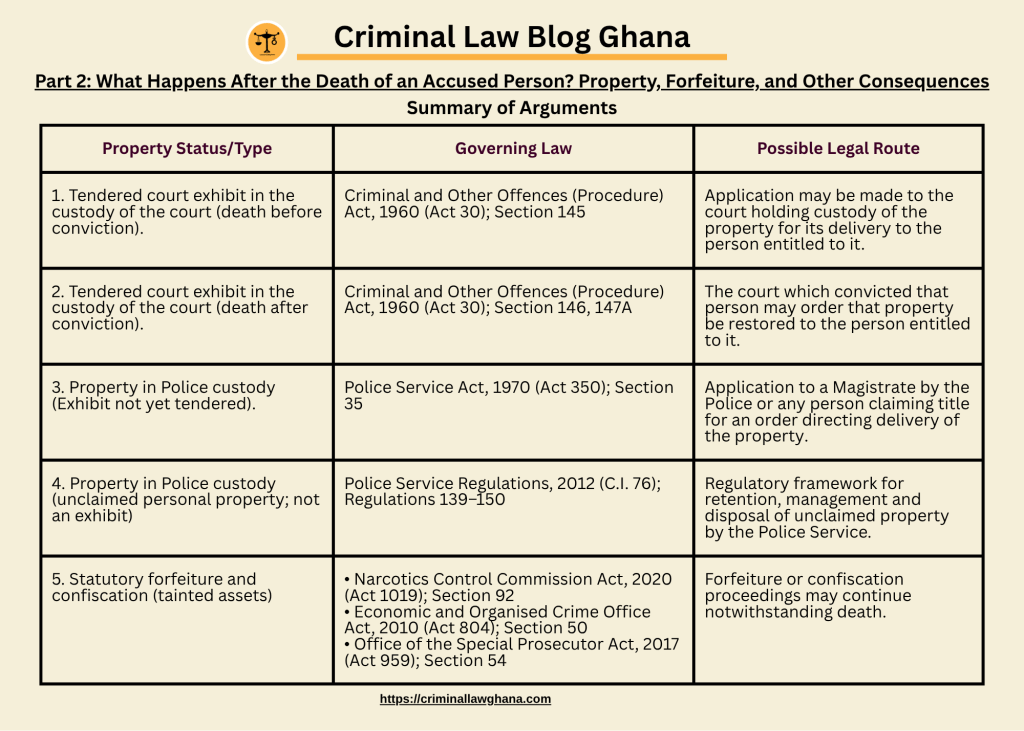
Conclusion
It is tempting to treat abatement as bringing all legal consequences to an end, but that is not always the case. Questions relating to property involved in criminal proceedings may survive the death of an accused. For victims seeking the return of stolen property, third parties claiming ownership, or the State dealing with tainted property, the court may still have work to do even after the criminal case has formally ended. With the first two situations, the absence of an express statutory answer may mean that different approaches are adopted in practice. Depending on the circumstances, practitioners may look to Act 30, the Police Service Act, the inherent jurisdiction of the court to deal with property in its custody, or other procedural mechanisms for securing the release of property. The analysis suggests that the critical question is often not whether the accused has died, but who has custody of the property at the time the proceedings terminate and which statutory regime governs its disposition. The result may often be the same even where the legal route differs.
What this article has sought to do is identify some of the legal frameworks that may become relevant once criminal proceedings terminate because of the death of the accused. While the law does not appear to provide a single answer for every situation, the article demonstrates that the end of the criminal case does not necessarily bring all questions concerning property to an end.
In Part 3, we will examine how some jurisdictions permit family members or personal representatives to continue appeals or seek posthumous review after the death of an accused person, and consider whether similar mechanisms should exist in Ghana.
A Final Note
If your property becomes involved in criminal proceedings, it is advisable to seek legal advice. As demonstrated, questions concerning the return, ownership, or disposal of property can be complex and may depend on the circumstances of each case.
Readers interested in the civil enforcement of restitution orders may also find this earlier Ghana Law Hub article useful: Full Article Here
A special thank you to Derrick Ackah-Nyamike, whose observations during a discussion of this topic prompted some of the jurisdictional questions explored above.
Subscribe to and follow Criminal Law Blog Ghana on our social media platforms for more practical insights into Ghana’s criminal justice system.

